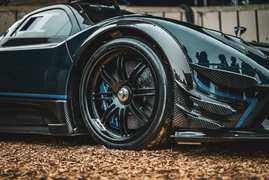

Yangwang U9: China’s Electric Hypercar Shatters Speed Records, Redefining Automotive Excellence
The year is 2025. For a decade, the automotive world has been captivated by the relentless pursuit of speed, a domain historically dominated by European titans and American muscle. We’ve witnessed groundbreaking innovations, monumental engineering feats, and the relentless march of the internal combustion engine towards its zenith. Yet, on a crisp September afternoon, a new contender emerged from the East, not with a roar of gasoline, but with the silent, electrifying surge of advanced electric propulsion. This wasn’t just another electric vehicle; this was the Yangwang U9, a Chinese EV that didn’t just enter the fray, it utterly redefined it, shattering existing benchmarks and igniting a seismic shift in the hypercar landscape.
For ten years, I’ve been immersed in the intricate world of automotive design and performance, analyzing everything from the most accessible daily drivers to the pinnacle of supercar engineering. I’ve seen trends come and go, technologies evolve at breakneck speed, and the landscape of performance vehicles constantly reshaped. But even with my extensive experience, the events of September 14th, 2025, stand out as a watershed moment. It was the day a sub-brand of BYD, known for its pragmatic approach to electrification, unveiled a machine that was anything but ordinary: the Yangwang U9 Xtreme.
The scene was set at the high-speed test oval at ATP Papenburg, a hallowed ground often reserved for Germany’s own performance flagships. On this particular Sunday, with the sun casting long shadows, German racing driver Marc Basseng was at the helm of the Yangwang U9 Xtreme. The air crackled with anticipation. Following a slightly unnerving 290 mph “wobble” on his initial run, Basseng, armed with a steely resolve and a remarkable composure, embarked on a second attempt. The objective was clear: to challenge the established order, to confront the reigning kings of the 300 mph club – names like Koenigsegg, Rimac, and Hennessey – and to plant a definitive flag for Chinese automotive innovation on the global stage.
What transpired next was nothing short of astonishing, a moment that sent shockwaves through every boardroom and design studio in the automotive industry. Marc Basseng, his nerve unwavering and his focus absolute, guided the Yangwang U9 Xtreme to an electrifying 308.4 mph. This monumental achievement didn’t just nudge the existing record; it obliterated it. It dethroned the Bugatti Chiron Super Sport 300+, which had held the title of the fastest road-legal car for six long years at 304.8 mph. The Yangwang U9 Xtreme, powered solely by electricity, had ascended to become the undisputed king of speed, etching its name into the annals of automotive history. This wasn’t just a speed run; it was a profound statement about the future of performance.
The sheer audacity of this accomplishment is underscored by the fact that the Yangwang U9 Xtreme outpaced a car renowned for its monstrous W16 engine and decades of aerodynamic refinement. The U9 Xtreme’s dominance isn’t a fluke; it’s a testament to a radical departure in engineering philosophy. While many combustion-powered hypercars struggle to breach the 1,000-horsepower mark, the U9 Xtreme operates on an entirely different plane. Its four independent electric motors, each capable of spinning at an astonishing 30,000 rpm, combine to unleash a staggering 2,978 horsepower. To put this into perspective, that’s more than double the output of the “standard” U9, which itself boasts an impressive 1,288 horsepower. The power-to-weight ratio is simply phenomenal, achieving an astonishing 1,217 horsepower per tonne.
Crucially, this level of performance is not attainable without a revolutionary electrical architecture. The Yangwang U9 Xtreme is the first production car to utilize a 1,200V system. This high-voltage architecture is absolutely essential for delivering the immense power required by its electric motors efficiently and without compromise. Furthermore, it can handle an astounding 1,000 amps of current, a figure comparable to what powers some electric trains. This signifies a leap in EV powertrain technology, pushing the boundaries of what was previously thought possible for a road-going vehicle. The implications for the broader electric vehicle market, from performance cars to everyday transportation, are profound, signaling a new era of accelerated charging and unprecedented power delivery capabilities.
For those seeking the absolute pinnacle of automotive engineering, the fastest electric car is no longer a question of ‘if’ but ‘when’. The Yangwang U9 Xtreme has answered that question emphatically. Its performance on the track is not just about raw speed; it’s about the integration of cutting-edge battery technology, advanced thermal management, and sophisticated electronic control systems. The development of such a vehicle demands not only immense financial investment but also a deep understanding of the nuanced interplay between power, efficiency, and safety at extreme velocities. The Chinese automotive industry, often perceived as a follower in the hypercar segment, has now firmly placed itself at the forefront of technological innovation.
But beating Bugatti at its own game, claiming the title of the fastest car in the world, was seemingly just the preamble for Yangwang’s ambitions. The U9 Xtreme has already proven its mettle in other demanding arenas. It has set a new lap record for production electric sports cars around the legendary Nürburgring Nordschleife, completing the torturous 12.9-mile circuit in an astonishing 6 minutes and 59.16 seconds. This blistering pace around the Green Hell further solidifies its status as a truly exceptional performance machine, capable of dominating both straight-line sprints and dynamic handling challenges. The Nürburgring, often considered the ultimate benchmark for automotive performance, has now witnessed the prowess of this Chinese electric marvel.
The pursuit of speed is an insatiable human desire, and Yangwang appears intent on pushing the limits even further. The next target is clear: breaking the 500 kph (approximately 311 mph) barrier. This is a frontier that very few vehicles, electric or combustion, have ever seriously contemplated. Achieving this would represent another monumental leap, further cementing the Yangwang U9 Xtreme’s legacy and signaling to the world that the era of the purely electric hypercar has truly arrived. The global automotive community, from seasoned enthusiasts to industry insiders, is watching with bated breath. The question on everyone’s mind is: what comes next from this groundbreaking marque?
The implications of the Yangwang U9 Xtreme’s success extend far beyond mere bragging rights in the hypercar segment. This achievement has a ripple effect across the entire automotive ecosystem. For consumers, it validates the potential of electric powertrains to deliver exhilarating performance, dispelling any lingering doubts about their capabilities. For manufacturers, it serves as a powerful incentive to accelerate their own EV development, particularly in the high-performance sectors. Investors in the electric vehicle market, especially those focused on high-performance EVs and luxury electric vehicles, will undoubtedly see this as a significant indicator of future growth and innovation.
The Chinese EV market has been a powerhouse of growth for years, but the Yangwang U9 Xtreme elevates this to an entirely new level. It demonstrates a commitment to pushing technological boundaries and creating halo products that capture global attention. This is not just about selling cars; it’s about building brand prestige and showcasing a nation’s technological prowess on the world stage. The development of such an advanced vehicle requires a robust supply chain, cutting-edge battery manufacturing, and significant investment in research and development. Yangwang, as a subsidiary of BYD, benefits from this extensive ecosystem, allowing for rapid innovation and scaling.
For those considering their next automotive acquisition, especially within the electric sports car category, the Yangwang U9 Xtreme presents a compelling, albeit exclusive, proposition. While its primary focus is on extreme performance, the underlying technology could eventually trickle down to more accessible models, further democratizing high-performance electric driving. The pursuit of the fastest electric production car has always been a driving force for innovation, and the U9 Xtreme has propelled this race forward with unprecedented vigor.
The future of hypercars is undeniably electric, and the Yangwang U9 Xtreme is a powerful harbinger of this shift. Its success challenges long-held assumptions about what electric vehicles are capable of, pushing the boundaries of speed, power, and technological sophistication. As we look towards 2026 and beyond, the automotive landscape will undoubtedly continue to be shaped by the innovations pioneered by companies like Yangwang. The race for automotive supremacy has a new champion, and it’s powered by electricity. The message is clear: the automotive world has been warned, and the future of performance is electrifying.
If you’re captivated by the relentless pursuit of automotive excellence and the groundbreaking advancements in electric vehicle technology, the Yangwang U9 Xtreme represents a pivotal moment. Explore the latest developments in hypercar innovation and discover how the future of high-performance driving is being shaped.